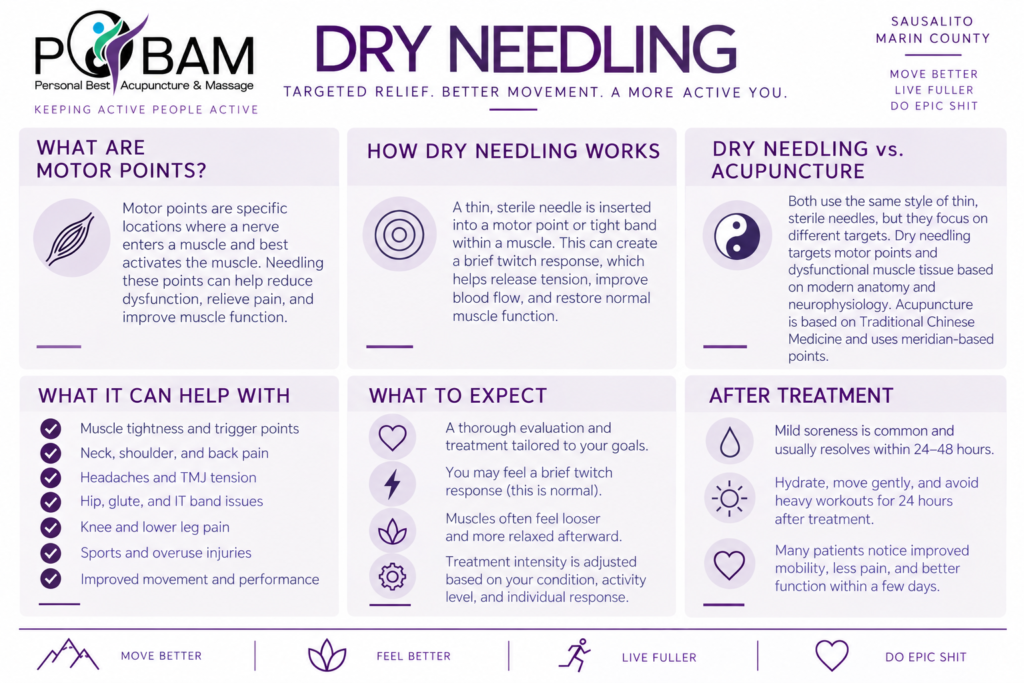
Dry Needling in Sausalito & Marin County
Is Dry Needling Different From Acupuncture?
Dry needling and acupuncture have far more in common than their names might suggest. In fact, dry needling can be understood as a modern Western medical adaptation of acupuncture that describes treatment using contemporary concepts of anatomy, physiology, myofascial trigger points, and motor points.
Acupuncturists have treated tender or painful areas known as ashi points for centuries. These are points identified through palpation rather than solely by their location on a traditional acupuncture meridian. Many of these areas overlap with what are now described as myofascial trigger points.
I explored this relationship extensively in my doctoral literature review, A Literature Review on Dry Needling and Traditional Acupuncture for Treating Myofascial Pain. Research reviewed in the paper found substantial anatomical overlap between commonly described trigger points and traditional acupuncture points. My review also found that the available evidence did not demonstrate that dry needling was superior to traditional acupuncture for treating myofascial pain or that its physiological mechanism was distinctly different.
So what makes dry needling different?
The primary difference is often how and why the needle is used, rather than the needle itself.
In dry needling, I locate a specific trigger point, motor point, or dysfunctional area of muscle and use the needle to stimulate that tissue. This may produce a brief involuntary muscle twitch followed by a feeling of release. Unlike many acupuncture treatments in which needles may remain in place for a longer period, dry needling often involves more direct stimulation of the targeted muscle.
The technique can be uncomfortable, and temporary muscle soreness afterward is common.
How I Use Dry Needling in My Practice
I rarely look at dry needling as a stand alone treatment. Depending on the condition and the individual patient, I may combine dry needling with retained acupuncture needles, electroacupuncture, massage, cupping, gua sha, and corrective exercise.
This is also why I don’t automatically dry needle every painful or tight muscle.
My training as an acupuncturist taught me to evaluate the whole person, not simply the painful area. A technique that is appropriate for a healthy athlete with a significant muscular restriction may not be the best choice for someone who is frail, highly sensitive, or whose movement problem requires greater stability rather than additional mobility.
Every treatment plan is individualized based on the patient’s condition, examination findings, activity level, goals, and response to treatment.
After a more intensive dry needling treatment, I generally recommend taking it relatively easy for the first 24 hours while any post treatment soreness settles.
Want to dig into the research? Read my doctoral literature review, A Literature Review on Dry Needling and Traditional Acupuncture for Treating Myofascial Pain.
What to Expect at Your Appointment
Your appointment begins with an assessment of your symptoms, movement, and relevant muscles and tissues. Treatment is individualized based on what I find, and I may reassess movement or function afterward and recommend corrective exercises when appropriate.
Book Dry Needling in Sausalito– Choose Acupuncture New Patient Appointment
Personal Best Acupuncture & Massage provides dry needling and orthopedic sports acupuncture & massage in Sausalito for patients throughout Marin County.
Dr. Samantha Hodges, DAOM, L.Ac., CMT